Bifold doors supply and fit, and where the gaps appear
Two quotes for the same opening can differ by thousands because one includes work the other quietly leaves to you. This page sets out what supply and fit should cover, and what supply only really means.
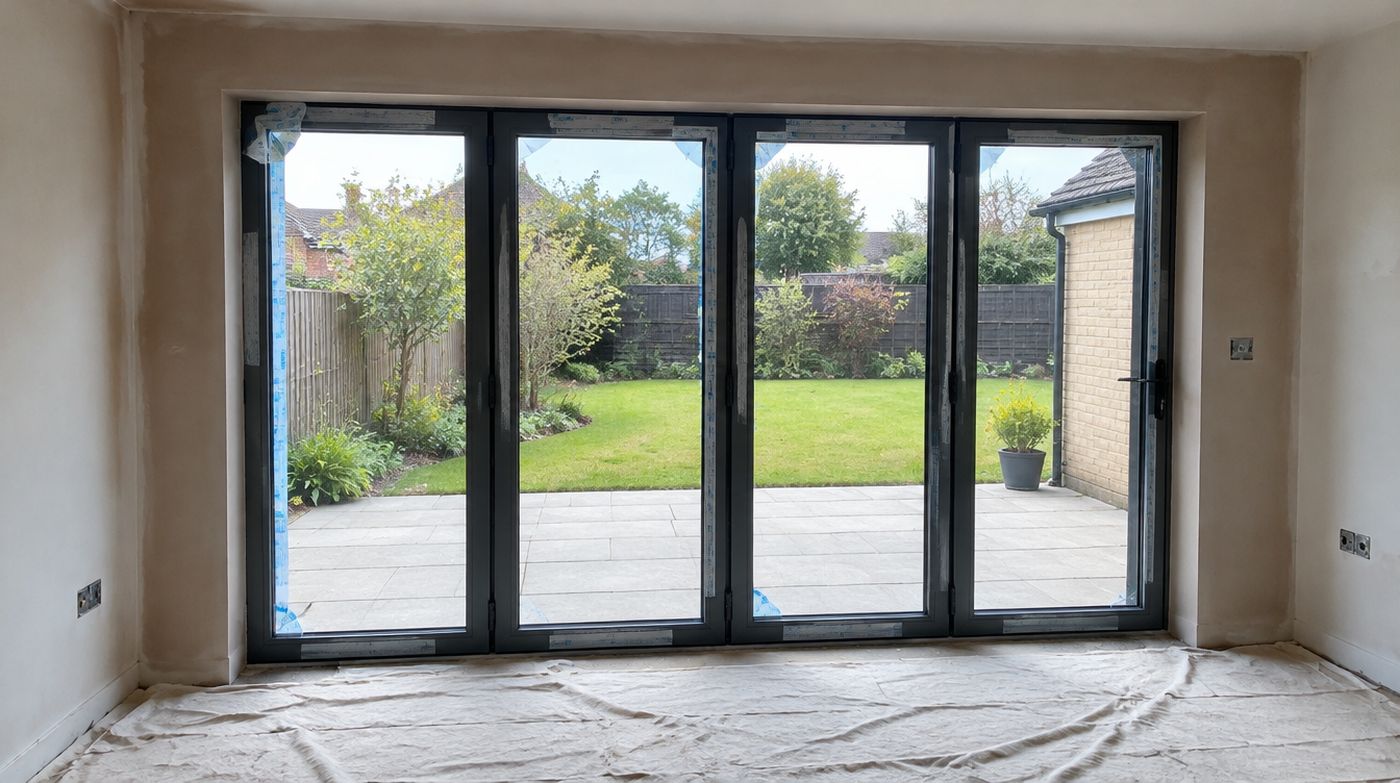
What bifold doors supply and fit should actually include
Bifold doors supply and fit means one company takes your opening from a measured hole to a working, sealed, locking set of doors. Written out properly that covers the final survey and the dimensions, manufacture of the frame and the panels, toughening and glazing of the sealed units, delivery to the address with whatever access it needs, removal and disposal of whatever is there now, fitting and fixing the outer frame on solid packers, hanging and adjusting the panels, bedding and sealing the threshold, perimeter sealing inside and out, trims, handover, and certification where it applies.
Read that list against your quote. Most disputes in this trade are not about quality at all. They are about one of those items having no owner.
Two of them are quietly dropped more often than the rest. Disposal is the first: a four metre aluminium frame and four sealed units are a skip load of waste, and if nobody has priced taking it away it sits in your front garden. Making good is the second, and it needs a standard rather than a word. Plaster brought to a finish ready for decoration is a different job from a smear of filler and a cover trim, and the quote should say which one you are buying.
What supply only leaves you holding
Supply only is a sale of goods. You give a supplier a set of dimensions, they manufacture a frame to those dimensions and deliver it to the kerb. From that moment everything is yours: the measurement risk, the lifting, the fixing, the sealing, the adjustment, and the argument if a sealed unit arrives scratched.
The measurement point is the one people underestimate. If the supplier measures, a frame that does not fit is their problem and they remake it. If you or your builder provide the numbers, a frame that does not fit is a new frame at full price, plus four to six weeks of a hole in your wall covered with plywood while it is made.
There are also two things supply only simply cannot give you. Nobody can issue a FENSA certificate for an installation they did not carry out, so a replacement bought supply only needs building control notification instead. And there is no installation guarantee, because no installer was involved. The doors may be guaranteed. The fit is not.
The scope gaps where money and blame get lost
Between a structural opening and a finished set of doors sits a list of small jobs that no trade assumes is theirs. These are the usual suspects:
- Making good internal reveals, head and plaster returns once the frame is fixed
- External making good to brickwork, render or cladding around the new frame
- Cavity closers, damp proof course and insulation at the jambs and the head
- Supply, setting and connection of a drainage channel in front of the threshold
- Screed and floor finish brought up to the threshold at the right level
- External paving taken up, relaid or cut in to meet the doors
- Access equipment, scaffold alteration or a glass lift where panels cannot be carried
- Parking suspension or permits, and removal of the old frames and glass
- Moving a radiator, a socket or a soil pipe sitting in the opening or the stack zone
None of these is expensive on its own. All of them together can add up to a serious figure, and they are the most common reason a finished job feels like it cost more than the quote. Go through that list with both your builder and your door company and write a name against every line. An hour with a biro on a Sunday afternoon is worth more than any amount of comparing headline prices.
Sequencing a door company and a builder so neither waits
Order of operations decides whether a bifold installation is calm or a fight. The structure goes in first: lintel or steel, propping removed, load taken. Then the opening is formed to the dimensions the door maker has asked for, with cavity closers and the damp proof course in place. Only then is the final survey carried out, and only after that survey is anything manufactured.
The doors are then fitted before the screed and floor finish go down, not after. That way the threshold is set to the level the finished floor will arrive at, and the floor is laid up to a frame that is already fixed and true. Doing it the other way round gives you either an unplanned lip or a frantic conversation about packing. The same logic applies outside: fit the doors, then lay or relay the paving to the channel and the fall.
One thing to push back on. Builders often prefer to form the opening generously and let the door company fill the difference, because an opening that is too small is their problem and an opening that is too big is yours. Fifty millimetres of packing behind a wide cover trim is not a finish, it is a gap with a lid on it. Insist on the dimension in writing and insist the opening is built to it.
The sequence also sets your lead time. Nothing is being manufactured while the builder is still working, so if the extension is six weeks from completion then the doors are six weeks plus the manufacturing period away. Plan the temporary boarding and warn the household. When to survey is covered in more detail on the main bifold doors page.
Who is liable when a bifold set leaks
There are only three candidates. The opening itself, through a failed damp proof course, an unsealed cavity closer or water tracking across a lintel. The doors, through a poor gasket, an unsealed corner joint or a failed sealed unit. Or the ground outside, where paving is too high, falls the wrong way, or a channel is not draining.
Separating them is not hard if you can test each one in isolation. Water that appears only in driving rain from one direction usually points at the opening or an external seal. Water sitting in the bottom track after any rain points at drainage. Condensation between panes is a failed sealed unit and nothing else. Water that arrives with a hosepipe on the threshold but never with rain is usually a fitting detail.
Keep the evidence while you can. Photograph the opening before the frame goes in, with the damp proof course and the cavity closers visible, and photograph the threshold bedding before the paving goes back. Twenty pictures on your phone will settle an argument that otherwise runs for months, and no honest trade objects to you taking them.
The reason supply and fit is worth paying for is not that it never leaks. It is that one company cannot point at anybody else. On a split job the supplier blames the fit, the fitter blames the frame, the builder blames both, and you spend a winter with a towel on the floor. If you do split the job, agree in writing who leads on a water test and who pays for the first investigation.
Supply and fit is only as good as the sentence that says where it stops. Get that sentence written down before you pay a deposit.
Whose numbers are they: measurement and responsibility
Make this explicit on the order. Either the dimensions on the paperwork are the supplier’s own surveyed figures, in which case they carry the risk, or they are figures you supplied, in which case you do. There is no middle position. A quote that says dimensions to be confirmed is a quote with the risk left dangling, and it will land on whoever is least able to argue.
If you are buying supply only, write on the order that the dimensions are yours, measure the opening yourself once the structure is finished, take width and height in three places and both diagonals, and order to the smallest width and height you find. Then allow a working tolerance at the jambs and the head. Ordering to the largest figure you measured is how a frame ends up being planed into brickwork on a Friday afternoon.
When supply only is genuinely the right choice
It is sometimes the better buy and we will say so. If you are part way through a full extension with a builder you trust, who has a joiner on the team and is already carrying the whole programme, a supply only set can work well and save you money. The same is true if you are a builder or a developer buying several openings and fitting them with your own people.
What makes it work is competence and a written division of responsibility, not the saving itself. What makes it fail is a homeowner buying doors online to save a few hundred pounds and then paying a general builder a day rate to learn an unfamiliar system on their house. If your builder has not fitted that particular door system before, ask him directly. A straight answer is worth more than a discount.
When you compare bifold doors supply and fit against supply only plus a fitting price, add the missing lines before you decide: delivery and offload, disposal, sealants and fixings, making good, the drainage channel, and the cost of a remake if the dimensions turn out to be wrong. Compared honestly, the gap is usually much narrower than it first looks.
FAQ
Questions about bifold doors supply and fit
Is supply and fit cheaper than supply only for bifold doors?
The headline figure is higher, but the comparison is rarely like for like. A supply only price covers the doors delivered to the kerb and nothing else, so you still have to pay for offload, fixings and sealants, fitting labour, perimeter sealing, making good inside and out, disposal of the old frames and any drainage channel. Add those and the gap narrows considerably. The bigger difference is risk: with supply only you own the dimensions, so a frame that does not fit is a new frame at full price rather than a remake at the supplier’s cost.
Can my builder fit bifold doors that I buy myself?
A competent builder with a joiner can fit a bifold set, and plenty do it well. The question is whether he has fitted that particular system before, because the fixing positions, the packing, the threshold bedding and the hinge adjustment differ between systems and the details are not obvious. Ask him directly rather than assuming. Also be clear that no FENSA certificate can be issued for an installation the manufacturer did not carry out, and that there will be no installation guarantee. If anything binds or leaks later, the diagnosis and the cost are both yours.
Who is responsible if supply-only bifold doors are the wrong size?
Whoever provided the dimensions, and that should be written on the order. If the supplier surveyed the opening, a frame that does not fit is remade at their cost. If you or your builder gave the figures, it is a new frame at full price with a fresh lead time. This is why supply only orders should state plainly that the dimensions are the customer’s, and why you should measure after the structural opening is finished rather than from a drawing, taking the smallest width and height you find across three positions.
Get a fixed price for your bifold doors
Send us the opening width and a photo, or book a free survey. We will come out, measure properly and quote in writing.