What drives the cost of bifold doors in London
There are no prices on this page, because a figure without a specification is worthless. What follows is every line that moves the total, so you can read a quote and see where the money went and what is missing.
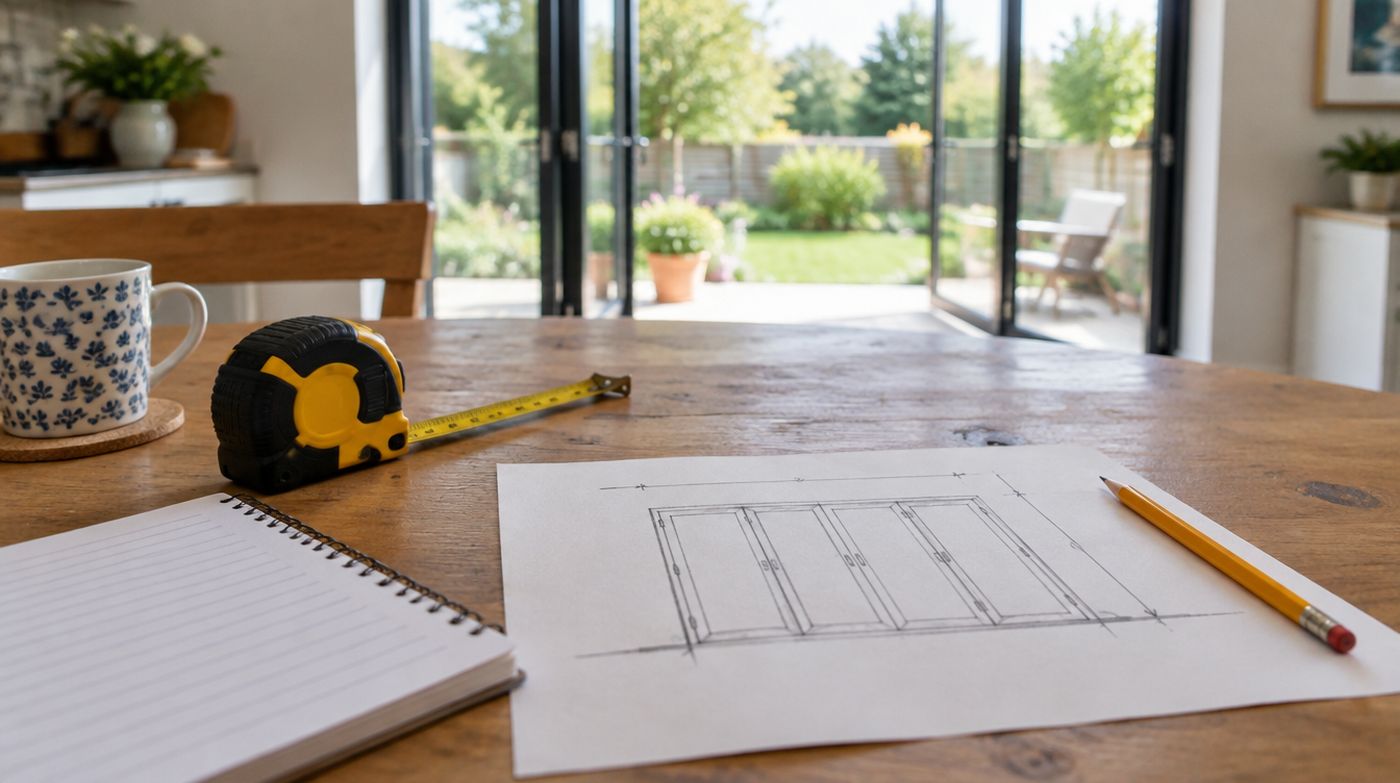
What makes up the bifold doors cost London installers quote
A quote for a bifold set is four things added together, and they move independently of each other. The aluminium and the hardware. The glass. The labour to survey, fit, seal and commission. And the logistics of getting four metres of frame and several heavy sealed units into a London property. Any useful discussion of bifold doors cost London homeowners face has to separate those four, because a cheap quote has nearly always cut one of them rather than found a cleverer way to do the whole job.
It also helps to know which of the four you can influence. The glass and the panel count are yours to decide. The access and the logistics are set by your house. The labour is set by the company you choose. Only the aluminium itself is close to a commodity, and that is precisely why it is the line most often downgraded without being mentioned.
Width, panel count and the price of one more leaf
Width is the obvious driver but panel count is the sharper one. Every additional leaf adds a hinge set, a carriage or roller, two more gasket runs, four more glass edges, another keep or guide, and the labour to hang and align it. Two sets covering the same opening, one with four panels and one with six, are not the same product and should not carry the same price.
Cost per metre is not linear either. It falls as the opening grows, because the survey, the delivery and the fitting day cost much the same whether the opening is 2.4m or 3.6m. Then it rises again once the leaves get wide or heavy enough to need upgraded gear, thicker glass and a stiffer head above. The cheapest metre of bifold sits somewhere in the middle, and the panel split is the lever you control. Practical limits on leaf width are covered on the main bifold doors page.
If you are trying to bring a figure down without losing quality, the panel count is the first place to look. A four panel set split three and one, with the single leaf configured as a traffic door, does almost everything a six panel set does in daily use. Six slim panels look impressive folded back and cost more to make, more to fit and more to keep adjusted. Very few households fold the whole set back more than a handful of times a year.
Glass is a bigger line than most people expect
Glass area scales with height as well as width, so a tall opening costs considerably more than people assume from the width alone. Safety glass is not optional: glazing in doors and in the critical locations beside them has to meet the impact requirements set out in Approved Document K, which in practice means toughened or laminated units. That is a baseline, not an upgrade, and any quote that appears to be saving money there is saving it somewhere it should not.
Above that baseline the real variables are coatings and construction. A low emissivity coating is standard. A solar control coating on the outer pane is an addition, and on a large south or west facing opening it is one of the very few upgrades that changes how the room actually feels to sit in. Acoustic laminated glass costs more again and only earns it next to a road or a railway.
Triple glazing is where money gets wasted. On a bifold the frame, the gaskets and the threshold dominate the heat loss, and the third pane adds weight that the hinges and carriages have to carry for the life of the doors. Unless your project is chasing a specific whole house performance target, a good double glazed unit with the right coating, fitted into a properly sealed opening, is a better use of the same money. Put the difference into the installation and the threshold detail.
Thresholds, drainage and what sits underneath
A weathered threshold comes with a standard set. A low threshold costs a little more. A flush threshold is where the figure jumps, and most of that increase is not in the door at all. A flush detail needs a drainage channel immediately in front of it, a fall away from the building, a connection to somewhere the water can actually go, and the internal and external levels coordinated before anything is manufactured.
That work is groundwork and drainage, and it is frequently quoted by the builder rather than by the door company. So if you compare a quote with a flush threshold against one with a weathered threshold and assume the difference is the door price, you will get a surprise later. Ask plainly which quote includes the channel and its connection. The threshold and drainage detail itself is covered on the patio bifold doors page.
The costs that are not in a door quote at all
Most blown budgets are not caused by the doors. They are caused by the ring of work around the doors that nobody put a price against:
- The structural opening: engineer’s calculations, steel or lintel, padstones and propping
- Building control notification or inspection where the work is not a straight replacement
- Plastering and decorating internal reveals, head and returns
- Screed, floor finish and any level change needed to meet the threshold
- External paving lifted and relaid, plus the drainage channel and its connection
- Scaffold alteration, a glass lift, or extra labour where panels cannot be carried in
- Parking suspension or permits, skip hire and waste removal
- Integral blinds, which need power and a decision before manufacture rather than after
Price these at the same time as the doors rather than afterwards. A bifold set is usually the most visible item in a project and it is rarely the largest line once that list has been added up honestly.
Access, parking and the London premium nobody itemises
A 3.6m aluminium frame and six sealed units have to arrive, and then they have to reach the back of the house. At a detached property with a driveway that is twenty minutes of work. In a Victorian terrace with no side access it means the frame and every unit coming through the hallway, past the newel post, with floors protected and the glass carried by enough people to do it safely. In an upper floor flat it can mean a mechanical lift or a hoist.
Then there is the city itself. Controlled parking zones mean a bay suspension or a permit, applied for in advance. Narrow streets with nowhere to unload add time at both ends of the day. Mansion blocks bring service lift bookings, restricted working hours and a managing agent who wants notice and insurance documents. Conservation area constraints can add survey and approval time before a single profile is cut.
This is the part of bifold doors cost London quotes that is hardest to compare, because almost nobody itemises it. Honest companies price it and show it on the quote. Be suspicious of a price that is identical for a ground floor rear extension in Wembley and a third floor flat off Marylebone High Street, because the second job costs more to carry out and that difference is coming from somewhere. Access by part of London is covered on the areas covered page.
Where a cheap quote has taken the money out
When one quote sits well below the others for the same opening, the saving is almost always in one of a small number of places. The profile may not be thermally broken, which means an aluminium bridge straight from outside to inside and condensation running down the frames in January. The powder coating may be a basic polyester rather than an architectural grade. The gear may be the cheapest carriage in the system, which performs perfectly for about two years.
Then there is the installation. Fitters paid a fixed price per opening work quickly, and the corners that get cut are the invisible ones: packers left out, brush seals omitted, drainage slots not cleared, sealant instead of a properly closed cavity, no making good at all. None of it shows at handover and all of it shows in the second winter, by which time the discount has long been forgotten.
So do not ask why the cheap quote is cheap, because you will get a story about overheads. Ask the cheap company to confirm in writing the profile system and whether it is thermally broken, the coating grade, the glass build, the threshold type, the panel split, and whether the fitters are employed or subcontracted. If the answers come back vague, you have your explanation.
A quote that is cheaper than every other quote is usually not a cheaper way of doing the same job. It is a smaller job wearing the same description.
Deposits, stage payments and what to insist is in writing
Expect a written fixed quotation after a survey rather than a price over the phone, and expect VAT to be stated separately. A deposit is normal on made to measure aluminium. More than roughly a third of the total, or any request for the balance before the doors are on site, is not. Keep the final payment until the set is fitted, locked, adjusted and tested with water, and say so at the point of ordering rather than on the day.
Also insist that the quote names a lead time from the final survey and states what happens if the surveyed dimensions differ from the ones quoted from. That single sentence prevents the most common argument in this trade, which is a price agreed from a sketch and then revised upwards once a surveyor has actually seen the opening.
FAQ
Questions about bifold doors cost london
Why do bifold door quotes vary so much for the same opening?
Because the quotes are usually for different products with the same name. The variables are whether the aluminium is thermally broken, the grade of the powder coating, the glass build and any coatings, the quality of the carriages and hinges, the threshold type, and whether the fitters are employed or subcontracted on price. Scope varies too: one quote may include disposal, making good, sealing and a drainage channel while another covers the doors and the fixing only. Ask every company to confirm those items in writing and most of the spread explains itself.
Do wider bifold doors cost more per metre?
Not in a straight line. Cost per metre tends to fall as the opening grows, because the survey, the delivery and the fitting day cost roughly the same for a 2.4m opening as for a 3.6m one. It then rises again once individual leaves become wide or heavy enough to need upgraded carriages, thicker glass and a stiffer structural head. Panel count matters more than raw width, since every extra leaf adds hinges, gaskets, glass edges and labour. The economical zone is a moderate number of sensibly sized leaves rather than many narrow ones.
What hidden costs come with bifold doors?
Mostly the work around the doors rather than the doors themselves. The structural opening and the engineer’s calculations, building control where it applies, plastering and decorating the reveals, screed and flooring brought up to the threshold, external paving relaid to form a fall, and a drainage channel with somewhere to discharge. Then the London items: parking suspensions, waste removal, scaffold alteration or a glass lift where panels cannot be carried through the house. Integral blinds also need a power supply decided before manufacture. Price the whole ring of work at the same time as the doors.
Get a fixed price for your bifold doors
Send us the opening width and a photo, or book a free survey. We will come out, measure properly and quote in writing.