What bespoke bifold doors actually get you
Almost every aluminium bifold sold in London is described as bespoke. The word stretches from a frame cut precisely to your opening to a stock size packed out with timber and hidden behind a wide trim.
Made to measure, or a stock size packed out to fit
Bespoke bifold doors should mean one thing: the frame is manufactured to the dimensions of your opening. Aluminium is cut to length job by job, so in principle every set is made to measure. In practice some companies work from a short list of sizes they buy in volume, drop the nearest one into your opening and fill the difference with timber and a generous cover trim.
There is an easy test. Ask for the frame width and height that will appear on the manufacturing order, and compare them against the surveyed opening. A working tolerance of around 10mm at each jamb and at the head is normal and necessary, because nothing in a London house is perfectly square and the frame has to be adjustable in order to be set true. Sixty millimetres of packing behind a wide trim is a different animal, and you are paying bespoke money for a stock frame.
Packing in itself is not a fault. What matters is the material. Solid plastic or hardwood packers at every fixing and hinge position, not softwood offcuts and expanding foam. Foam is an insulator, not a structure, and a frame carrying four or six panels has to bear on something that will not compress over the years.
Where bespoke genuinely changes the result
The honest answer is that bespoke bifold doors earn their money at the edges of a job rather than in the middle. On a plain rectangular opening in a new extension, made to measure gets you a frame that fits and nothing more exotic than that. On the following, it changes what is actually possible.
Unequal panel splits are the most useful. If your opening is 3.2m wide and you want the traffic door to line up with a kitchen island, or to sit clear of a step, the panels do not have to be equal. Height is the second: where a steel sits low, or where you want the maximum glass under a fixed head, the frame can be made to the height you have rather than to the nearest standard. Third are narrow leaves designed to work around a structural post, a chimney breast return or a corner.
Corner sets are bespoke by definition, because the two runs have to be manufactured as a matched pair with a moving corner that closes without a post. That depends on the opening above being supported properly, which is a structural engineer’s decision rather than a glazing one. The corner configuration is covered on the aluminium bifold doors page.
Internal bifolds are the other place where made to measure does real work. A slim framed glazed set dividing a kitchen from a garden room has no weather seal to worry about, so the whole design is about sightlines and fitting a frame into a stud or masonry opening that was never built square. There you are buying precision rather than performance, and it is usually worth it because an internal set sits at eye level in the middle of the house where every gap shows.
Dual colour, RAL finishes and what they really cost
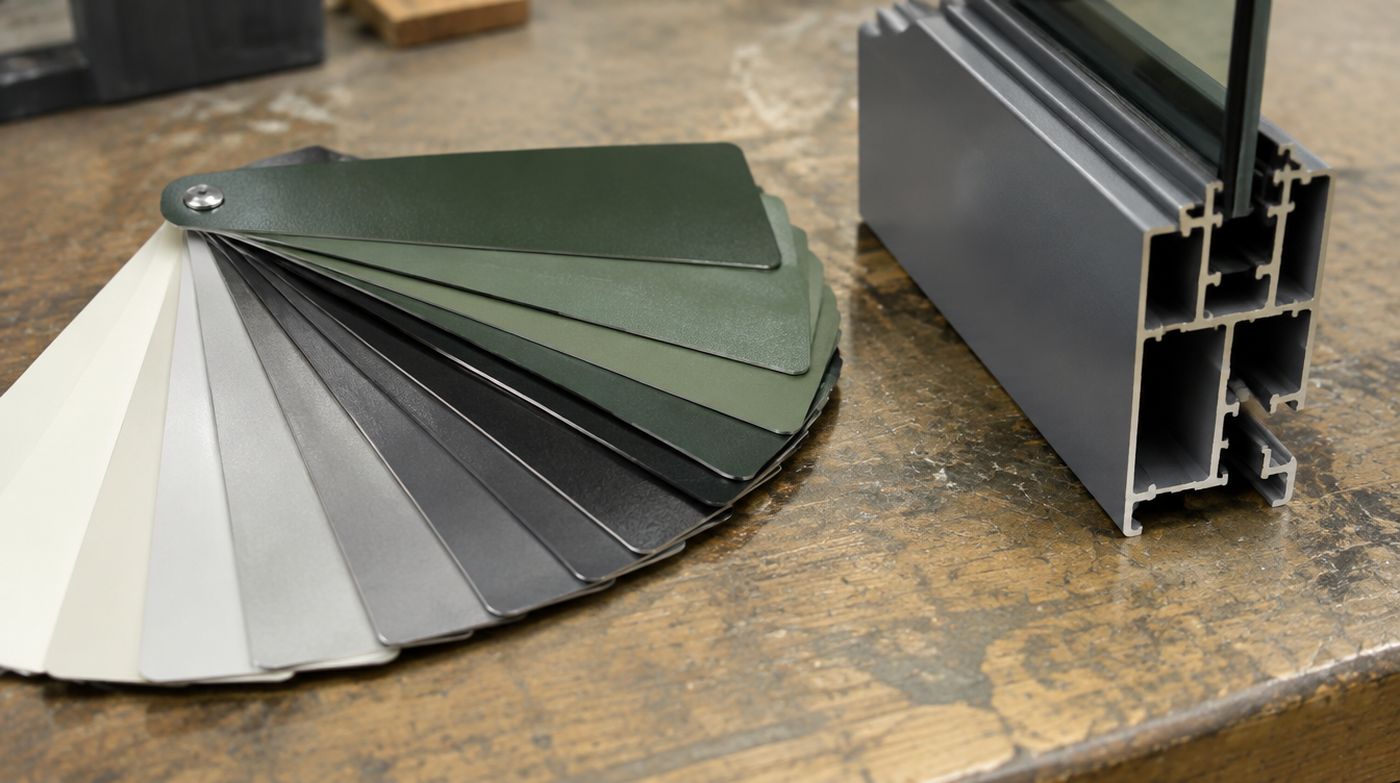
Powder coating is applied to the finished profile, so colour is a process rather than a stock item. That means almost any RAL is available, and it also means dual colour, where the outside and the inside are coated differently, requires masking and a second pass through the plant. It costs more and it adds days rather than weeks.
Dual colour is worth paying for in two situations: when the exterior has to match existing windows or a conservation area expectation while the interior has to suit a light internal scheme, and when a dark exterior colour carried inside would make a small north facing room feel like a cave. Outside those two cases it is a preference, and preferences are perfectly fine as long as you know that is what you are buying.
Here is where to save money. Anthracite grey, RAL 7016, is by a wide margin the most commonly specified exterior colour in London. It is effectively a standard, most coaters hold it, and nobody should be charging you a bespoke premium for it. If a quote carries a special colour surcharge for 7016 or for a plain white, question it and watch what happens.
One technical point worth knowing. Architectural powder coatings are specified against recognised durability classes, and a high durability or marine grade makes sense on severely exposed or coastal elevations. Across most of London a standard architectural grade is the correct specification and the upgrade adds cost without adding life. Ask which grade is quoted rather than assuming it is the better one.
Glass that is specified rather than chosen from a list
On a genuinely bespoke set the glass is designed for the opening rather than picked from three options. That means naming the build: the toughened or laminated construction, the cavity, the low emissivity coating, and whether a solar control coating is needed on the outer pane. A large south or west facing opening onto a London garden will cook the room behind it if the glass has no solar control, and the fix afterwards is blinds you never wanted.
Acoustic laminated glass is the other specification that genuinely earns its money, and only in one situation: a door set facing a busy road or a railway line. On a quiet rear garden it does very little and costs real money, so do not let it be added as a routine upgrade. The full glass build, pane by pane, is covered on the aluminium bifold doors page and we will not repeat it here.
Awkward openings: out of square, low heads and posts in the way
This is where bespoke stops being a marketing word. An opening in a Victorian terrace that has moved over a century can be out of square by a surprising amount, and the head can run out of level across its width. A frame can be manufactured with a raking head or a tapered jamb to follow it, and a cill can be scribed to an existing stone threshold.
The real question is whether you should. Making a frame follow a crooked opening preserves the crookedness forever, and a bifold needs a level threshold to run properly whatever the brickwork is doing. Nine times out of ten the better answer is to make the opening true first, with a packed and levelled base and plumb jambs, and then fit a rectangular frame into it. Paying a premium for a parallelogram is usually paying to keep a problem.
When bespoke bifold doors are not worth paying for
If your opening is being built from scratch, ask the door maker for its preferred dimensions and have the builder build to them. A set made at a size the workshop is set up for, in an opening built to suit it, is a better job than a bespoke frame fitted into whatever the builder happened to leave behind. You get the same result and you stop paying for problem solving that nobody needed to do.
Be similarly careful with bespoke hardware and exotic finishes on an elevation nobody looks at. A side return with two metres to the neighbour’s wall does not need a special colour, and a handle in a boutique finish is the first thing to look tired. Put the money into the glass specification, the threshold detail and the installation. Those are the three things you cannot change later without taking the doors back out.
What bespoke should never mean
Bespoke bifold doors should not mean a door set you cannot get parts for. Ask which system the doors are built on, whether the gear and the gaskets are stocked in the UK, and what happens in eight years when a roller or a hinge needs replacing. Some very cheap imported sets use proprietary hardware with no supply chain behind it, and when a part fails the only answer offered is a whole new door.
It should not mean an open ended lead time either. Made to measure aluminium takes weeks rather than days, and a special colour or a corner set adds to that. Get the period in writing, measured from the final survey rather than from the deposit, and understand that once the aluminium is cut and coated, a change of mind is a new frame at full price. Decide the configuration before you order, not during manufacture.
Bespoke should describe the dimensions of the frame, not the size of the invoice.
- The frame width and height going onto the manufacturing order
- The panel split, the fold direction and which leaf is the traffic door
- The glass build, pane by pane, including any coating
- The exterior and interior colours, with the coating grade named
- The threshold type, and who provides and connects the drainage
- The lead time from final survey, and whether gear and gaskets are stocked in the UK
Those six lines on an order are what separates a bespoke set from a stock set with a bespoke price. Ask for them in writing and most of the rest of the decision makes itself.
FAQ
Questions about bespoke bifold doors
Are bespoke bifold doors more expensive than standard sizes?
Usually a little, but far less than people expect, because aluminium is cut to length for every job anyway. The genuine premiums sit elsewhere: unequal panel splits, a non standard height, a special or dual colour, a corner set, or a frame made to follow an out of square opening. If your opening is being formed from scratch, the cheapest route is to ask the door maker for its preferred dimensions and have the builder build to them. You then get a frame that fits precisely without paying for anything unusual.
Can bespoke bifold doors be made for an out of square opening?
Yes. A frame can be manufactured with a raking head or a tapered jamb, and a cill can be scribed to an existing threshold. Whether it is the right answer is another matter. A folding set needs a level threshold to run properly, and following the existing geometry locks the fault in permanently. In most older London properties the better and often cheaper solution is to pack and level the base, bring the jambs plumb, and then fit a rectangular frame. Keep bespoke geometry for openings that genuinely cannot be corrected.
Can I have bespoke bifold doors in two different colours?
Yes, and it is a common choice. Dual colour means the external and internal faces are powder coated separately, so the profile is masked and goes through the coating plant twice. That adds cost and a few days to the lead time. It is worth it when the outside has to match existing windows or a conservation area expectation while the inside needs to suit a lighter scheme. Bear in mind that anthracite grey, RAL 7016, is effectively a standard colour in London and should not attract a special colour surcharge.
Get a fixed price for your bifold doors
Send us the opening width and a photo, or book a free survey. We will come out, measure properly and quote in writing.