How to choose bifold door installers in London
Most bifold problems are installation problems, not product problems. This page is about telling a competent installer from a confident salesman before you part with a deposit.
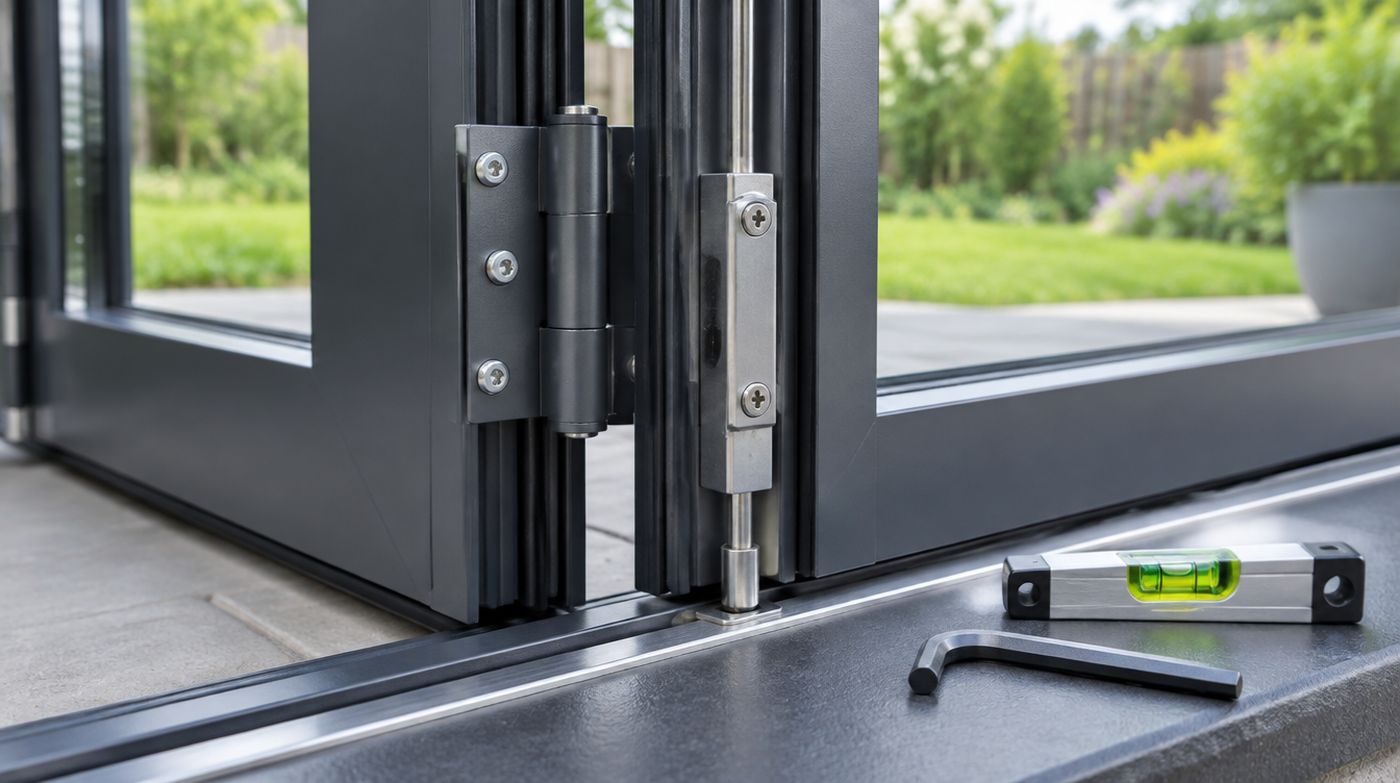
How do you judge bifold door installers London has to offer?
Almost every company selling aluminium bifolds in London buys its profile from one of a handful of systems houses. The extrusion, the running gear, the gaskets and the locking are largely the same ingredients across the market. So the bifold door installers London homeowners get to choose between are far more alike than the brochures suggest, and you are usually not comparing products at all. You are comparing who measures the opening, who makes the frame up, who stands in the hole on fitting day, and who answers the phone eighteen months later when a panel needs a quarter turn on a hinge.
That is the whole job. A premium set fitted into an opening that runs 15mm out of level, packed with offcuts and sealed with a fat bead of silicone, will bind within a year. A sensible mid range set fitted onto a true threshold, fixed through solid packers at every hinge position and sealed properly front and back, will run smoothly for a decade. Judge the people. The brochure is the least informative thing in the folder.
What a proper bifold survey looks like
A surveyor who knows the product spends most of the visit looking at the floor and the head, not at colour swatches. Expect a long level or a laser across the full width of the opening, and expect to be told the figure. Openings are rarely perfect. Twelve millimetres of run across four metres is normal and can be dealt with. Nobody can deal with it if it is never measured.
They should ask what is holding the wall up above the opening and want to see it, or see the drawing. They should check the head for deflection, because a top hung set transfers the weight of every panel into it. They will measure width and height in at least three places, take both diagonals to see how square the opening is, and look at where the panels will stack. A downpipe, a soil stack, a boiler flue or a meter box in the stack zone changes the configuration, and it is cheaper to change the configuration than to move the stack.
They should also ask questions that are about your house rather than about doors. Which way does the opening face. What is the floor build up going to be. Is the paving outside being relaid, and where does surface water go now. A surveyor who does not ask about the ground outside is not thinking about the threshold, and the threshold is where bifolds leak.
If the visit lasts fifteen minutes and ends with a price that is only valid until Friday, you have had a sales call rather than a survey. Thank them and carry on looking.
Questions worth asking before you sign anything
- Who will fit the doors: your own employed teams, or a subcontract crew I have not met?
- Who takes the final measurements, and is that before or after the builder has formed the opening?
- What exactly is the threshold detail, and who is responsible for drainage in front of it?
- Is the glass build written down, pane by pane, including whether it is toughened or laminated and what coating it carries?
- What is the lead time measured from the final survey, not from the deposit?
- Who makes good internally and externally, in what material, and to what finish?
- Does the guarantee cover the doors only, or the installation as well, and for how long each?
Ask them on the phone before you book a visit. The answers take two minutes and they thin the field faster than reading reviews. Pay particular attention to the first one. A company that uses its own installation teams can train them, send the same people back and carry the consequences of a bad fit. A company that subcontracts on price has handed the most important part of your job to the lowest bidder.
What FENSA registration proves, and what it does not
FENSA registration means an installer is assessed against the building regulations that apply to replacement windows and doors, and can self certify the work rather than involving building control. You get a certificate lodged against your address, and your solicitor will ask for it when you sell. It is worth having, and for a straight replacement you should not use an unregistered firm.
What it does not prove is that the aluminium is any good, that the fitters will protect your floor, or that the company will still be trading in five years. Registration is a floor, not a ranking. Treat it as a filter and then do the real assessment yourself, because a great many registered firms are ordinary and a few are poor.
One thing people get wrong. If your bifolds are going into a brand new opening as part of an extension, compliance for that opening normally sits with building control under the main works rather than with a FENSA certificate. Ask directly who is certifying what. Homeowners regularly finish an extension assuming the door company has covered a sign off it was never in a position to issue.
Insurance, guarantees and when to hand over money
Two different things get confused here. Public liability insurance protects you if an installer damages your property or injures someone while working. A guarantee covers the doors and the workmanship afterwards. Ask for both, and ask for the period on the doors and on the installation separately, because they are frequently not the same number.
An insurance backed guarantee is a policy that pays for remedial work if the company stops trading. On a large order it is genuinely useful. Read the exclusions, because most of them exclude glass breakage, wear on moving parts after a short initial period, and anything caused by movement in the building. That last exclusion is exactly why the structural question matters so much at survey.
On money, a deposit is reasonable. Made to measure aluminium is cut and coated for your opening and cannot be sold to anyone else. A deposit of more than roughly a third of the order, or a request for the balance before the doors have even arrived, is not reasonable. Keep the final payment until the doors are in, every panel has been folded and locked by you, and a bucket of water has been thrown at the threshold. That is the one moment in the whole process where being firm costs you nothing and protects everything.
How a bad installation shows itself six months later
Very few poor installations look poor on handover day. The fitters have just adjusted the set on a mild afternoon and it will glide. The problems arrive with the first cold snap and the first week of driving rain from the wrong direction.
The symptoms are consistent. The lead leaf starts catching the jamb and you find yourself lifting the handle to get the shootbolts to engage. Panels drop at the outer corner, so the gap along the top of the fold opens up unevenly. The bottom track fills with grit because the brush seals were left out or crushed during fitting, and the rollers begin to graunch. Water sits in the track instead of draining, and eventually finds the inside face of the threshold.
Inside, you see what the silicone was really doing. If the frame was packed with softwood offcuts or with foam and nothing else, the plaster return cracks along the frame line as the packers compress under load. A bead of sealant three times the width it ought to be is a confession, not a finish.
So when you are shortlisting, ask to see a job that is two or three years old rather than one finished last week. Any installer in London can show you a set commissioned on Tuesday. Far fewer will take you to one that has been through three winters, and the ones who will are the ones to shortlist.
Warning signs on the quote and on the sales visit
A price that drops sharply if you commit on the day tells you the first price was invented. Made to measure thermally broken aluminium has a cost floor made of metal, glass, powder coating and labour, and nobody discounts their way below it without taking something out. If a quote falls by a quarter in one conversation, ask what has left the specification, because something has.
Then look for what is missing rather than what is promised. A quote with no panel count, no fold direction, no threshold type and no glass build is a number, not a quote. A quote that does not say who makes good internally and externally has left a job for somebody, and that somebody will be you, at a point when every other trade has gone home.
Be equally wary of a company that agrees with everything. If you ask for a seven panel set with a flush threshold on a south facing opening at the bottom of a sloping garden and nobody raises drainage, solar gain or the width of each leaf, they are selling rather than thinking. The firms worth using will tell you what not to do. We talk people out of a configuration most weeks, and nobody has ever complained about it afterwards.
If a quote does not state the panel count, the fold direction, the glass build and the threshold type, there is nothing in it to hold anyone to.
Where bifold door installers stop, and who picks up after
Draw the boundary before work starts. Forming and supporting the structural opening is builder and structural engineer territory, not glazing. The best bifold door installers London has will draw that line for you at survey rather than leaving you to find it on the day. Screed and floor finishes up to the threshold, external paving and the connection of any drainage channel, plastering beyond the frame line, and power for integral blinds all sit outside a door installation unless somebody has written them into the quote. How that boundary is drawn, and what supply and fit does and does not cover, is set out on the supply and fit page.
Our own position is simple enough. We survey, we make the doors in our Wembley workshop, our own teams fit them, and if a panel needs adjusting we come back. If your job needs structural work or groundwork first, we will say so at survey and tell you to get it priced before you order doors. Ordering made to measure doors for an opening that does not exist yet is the most expensive mistake in this trade.
FAQ
Questions about bifold door installers london
How do I check a bifold door installer is FENSA registered?
FENSA keeps a public register you can search by company name or postcode, so take the registration number off the quote and check it yourself rather than trusting a logo on a van. Registration sits with the company, not with an individual fitter, so ask whether the people turning up are employed by that registered business. Remember the certificate only applies to replacement work. If your bifolds go into a brand new opening formed as part of an extension, that opening is normally signed off through building control under the main works instead.
Should the company that makes bifold doors also fit them?
It is not essential, but it removes the argument that costs homeowners the most time. When one company surveys, manufactures and installs, there is nobody to blame for a frame that does not fit or a threshold that lets water past. Where the job is split, the supplier points at the fit, the fitter points at the frame and you pay for the investigation. If you do split it, agree in writing who owns the dimensions and who leads on a water test, and take photographs of the opening before the frame goes in.
What should a bifold door installer measure before making the doors?
Width and height in at least three places each, both diagonals to establish how square the opening is, and level along the full length of the threshold line. They should also record what supports the wall above, what the finished internal floor level will be once screed, insulation and the floor finish are in, and what the external paving level and fall will be. Finally they should note anything in the stack zone, such as a downpipe, soil stack or meter box. A survey that produces only a width and a height is not a survey.
Get a fixed price for your bifold doors
Send us the opening width and a photo, or book a free survey. We will come out, measure properly and quote in writing.